InverseSquareFluxScaling#
- class sunkit_spex.models.scaling.InverseSquareFluxScaling(observer_distance=<Quantity 1. AU>, **kwargs)[source]#
Bases:
FittableModelInverseSqaureFluxScaling model converts luminosity output of physical models to a distance scaled flux.
- Parameters:
energy_edges – Energy edges associated with input spectrum
observer_distance – Distance of the observer from the source.
Examples
import astropy.units as u
import numpy as np
import matplotlib.pyplot as plt

from sunkit_spex.models.scaling import InverseSquareFluxScaling
from sunkit_spex.models.models import StraightLineModel

y_units = u.ph*u.keV**-1*u.s**-1
x_units = u.keV

ph_energies = np.arange(4, 100, 0.5)*x_units
ph_energies_centers = ph_energies[:-1] + 0.5*np.diff(ph_energies)

sim_cont = {"slope": -2*y_units/x_units, "intercept": 100*y_units}
source = StraightLineModel(**sim_cont)

plt.figure()
for i, d in enumerate([0.25,0.5,1]):
    distance =  InverseSquareFluxScaling(observer_distance=d*u.AU)
    observed = source * distance
    plt.plot(ph_energies_centers ,  observed(ph_energies), label='D = '+str(d)+' AU')
plt.loglog()
plt.legend()
plt.show()
(
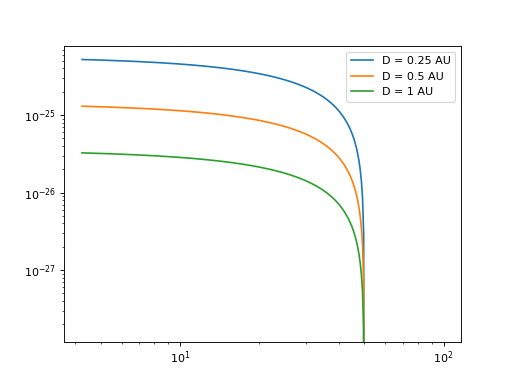
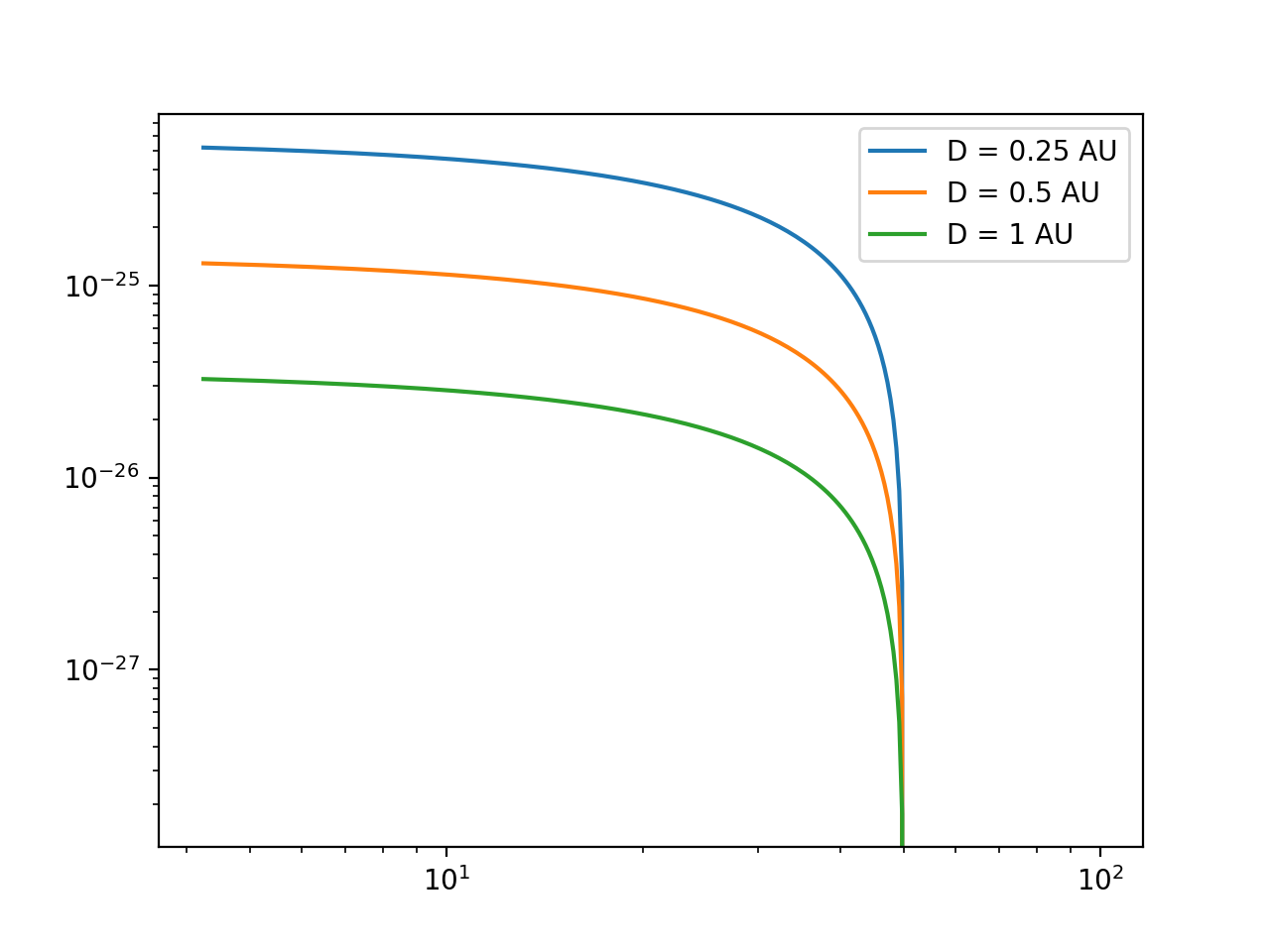
Source code,png,hires.png,pdf)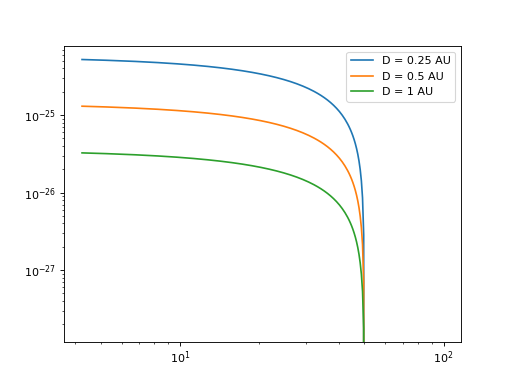
Attributes Summary
Names of the parameters that describe models of this type.
This property is used to indicate what units or sets of units the output of evaluate should be in, and returns a dictionary mapping outputs to units (or
Noneif any units are accepted).Methods Summary
__call__(*inputs[, model_set_axis, ...])Evaluate this model using the given input(s) and the parameter values that were specified when the model was instantiated.
evaluate(x, observer_distance)Evaluate the model on some input variables.
Attributes Documentation
- n_inputs = 1#
- n_outputs = 1#
- name = 'InverseSquareFluxScaling'#
- observer_distance = Parameter('observer_distance', value=1.0, unit=AU, fixed=True)#
- param_names = ('observer_distance',)#
Names of the parameters that describe models of this type.
The parameters in this tuple are in the same order they should be passed in when initializing a model of a specific type. Some types of models, such as polynomial models, have a different number of parameters depending on some other property of the model, such as the degree.
When defining a custom model class the value of this attribute is automatically set by the
Parameterattributes defined in the class body.
- return_units#
Methods Documentation
- __call__(
- *inputs,
- model_set_axis=None,
- with_bounding_box=False,
- fill_value=nan,
- equivalencies=None,
- inputs_map=None,
- **new_inputs,
Evaluate this model using the given input(s) and the parameter values that were specified when the model was instantiated.